
 Tokyo Story (1953)
- Drama
An
old couple visit their children and grandchildren in the city; but the children
have little time for them.
Director: Yasujirô Ozu
No story could be simpler. An old couple come to the city to
visit their children and grandchildren. Their children are busy, and the old
people upset their routines. In a quiet way, without anyone admitting it, the
visit goes badly. The parents return home. A few days later, the grandmother
dies. Now it is the turn of the children to make a journey.
From these few elements Yasujiro Ozu made
one of the greatest films of all time. "Tokyo Story" (1953) lacks
sentimental triggers and contrived emotion; it looks away from moments a lesser
movie would have exploited. It doesn't want to force our emotions, but to share
its understanding. It says, yes, a movie can help us make small steps against
our imperfections. It does this with characters so universal that we recognize
them instantly -- sometimes in the mirror. It was made 50 years ago in Japan
and it is about our families, our natures, our flaws and our clumsy search for
love and meaning. It isn't that our lives keep us too busy for our families.
It's that we have arranged them to protect us from having to deal with big
questions of love, work and death. We escape into truisms, small talk and
distractions. Given the opportunity at a family gathering to share our hopes
and disappointments, we talk about the weather and watch TV.
Ozu is not only a great director but a great teacher, and after
you know his films, a friend. "Tokyo Story" opens with the distant
putt-putt of a ship's engine, and bittersweet music evokes a radio heard long
ago and far away. There are exterior shots of a neighborhood. He likes trains,
clouds, smoke, clothes hanging on a line, empty streets, small architectural
details, banners blowing in the wind (he painted most of the banners in his
movies himself).
His visual strategy is as simple (therefore as profound) as
possible. His camera is not always precisely three feet above the floor (the
eye level of a Japanese person seated on a tatami mat) which always reflect his
exact feeling about the scene. Every single shot is intended to have a perfect
composition of its own, even if that means there is continuity errors. All the
shots are framed in some way. If there is movement in an Ozu film, it comes
from nature or people, not from the camera. He often shows a room before people
enter, and lingers a second after they leave. If characters go upstairs, they
are absent precisely long enough to actually do that. If a character is
speaking, he shows the entire speech. No cutaways, no listening shots, no overlapping
dialogue. He is comfortable with silences. Sometimes characters speak little
and imply much; the old father in "Tokyo Story" often smiles and says
"yes," and what he means is sometimes yes, sometimes no, sometimes
deep regret, sometimes a decision to keep his thoughts to himself.
Consider the Hirayama
family in "Tokyo Story." Shukichi, the grandfather and Tomi, the
grandmother. She is overweight and plain-faced; he has a tall, fallen grace. There
are no extravagant displays of affection between them. We learn that he drank
too much as a young man, then stopped. There are hints that their marriage was
imperfect, but endured.
Living at home with them
is their youngest daughter Kyoko, one of the many unmarried children in Ozu's
films who live with their parents. Their
youngest son Keizo works in Osaka, midway on their train journey. In Tokyo,
their oldest son Koichi is a doctor in a neighborhood clinic -- not as
distinguished as his parents imagined. He is married to Fumiko, and they have
two sons. His sister Shige is married and runs a beauty salon. A middle son was
killed in World War II; their daughter-in-law Noriko has never remarried and is
an office worker living in Tokyo.
There is an extraordinary scene soon after the old parents
arrive. "These are your grandparents," Fumiko tells her oldest son,
Minoru. And then to her mother-in-law: "Minoru is in middle school
now." So this is the first time he has met them, yet he escapes quickly to
his room. Ozu's lifelong theme is the destruction of the Japanese family
through work and modernization, and in only two lines of dialogue, he shows us
how the generations have drifted apart.
The grown children mean well. They try to make time for their
visitors. There is a moment of rich humor when we join them all on a tour bus,
everyone bouncing and leaning in unison. But old folks spend most days
"resting" at home because no one is free to take them anywhere. When her
husband brings home cakes for his parents, Shige says they're too expensive,
and the old folks won't appreciate them; while discussing this, they eat the
cakes. Oddly, the person who treats them most kindly and makes time for them is
Noriko, the widow of their middle son.
The others feel bad that they can't spare more time for their
parents and hit on a solution: They'll send them for a holiday to Atami Hot
Springs. Shukichi and Tomi did not come to Tokyo to go to a spa, but they
agree. At the spa, we see young people dancing and playing cards, and then, in
one of those perfect Ozu shots, two pairs of shoes placed neatly side by side
outside the old couple's door. The next morning, as they're sitting side by
side on a sea wall, he says, "Let's go home."
The last night in Tokyo is made of two wonderful sequences. Tomi
goes to stay with Noriko, and Shukichi says he will visit an old friend from
the village. Tomi and Noriko have a warm and loving conversation (the old woman
tells her son's widow she should remarry), and Shukichi gets plastered with two
former village friends. As they drink, they complain about their lives and
children, and we see how alcohol helps them break through the resolutely
positive Japanese public face.
All through the movie, Tomi and Shukichi discuss their
disappointment in such guarded words, punctuated with so many nods and
agreements, that their real feelings are hidden in code. Notice how they
criticize their grandchildren by saying they prefer their children. Listen how
they agree their children are "better than average."
The old people go home, the mother dies, and the family
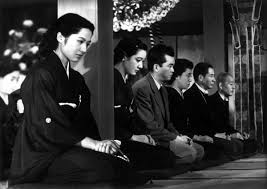
assembles for the funeral -- at last all lined up together in one row for Ozu's
camera. Now there are real tears, even from those who resented the visit.
Chishu Ryu, that wonderful actor, is masterful in the way he buries the old
man's grief in nods, agreement, pleasantries and routine. When the old woman
next door stops by to express her sympathy, he makes what for him is an
outpouring of grief: "Oh, she was a headstrong woman ... but if I knew
things would come to this, I'd have been kinder to her." A pause, "Living
alone like this, the days will get very long."

അഭിപ്രായങ്ങളൊന്നുമില്ല:
ഒരു അഭിപ്രായം പോസ്റ്റ് ചെയ്യൂ